
Remembering The Cause
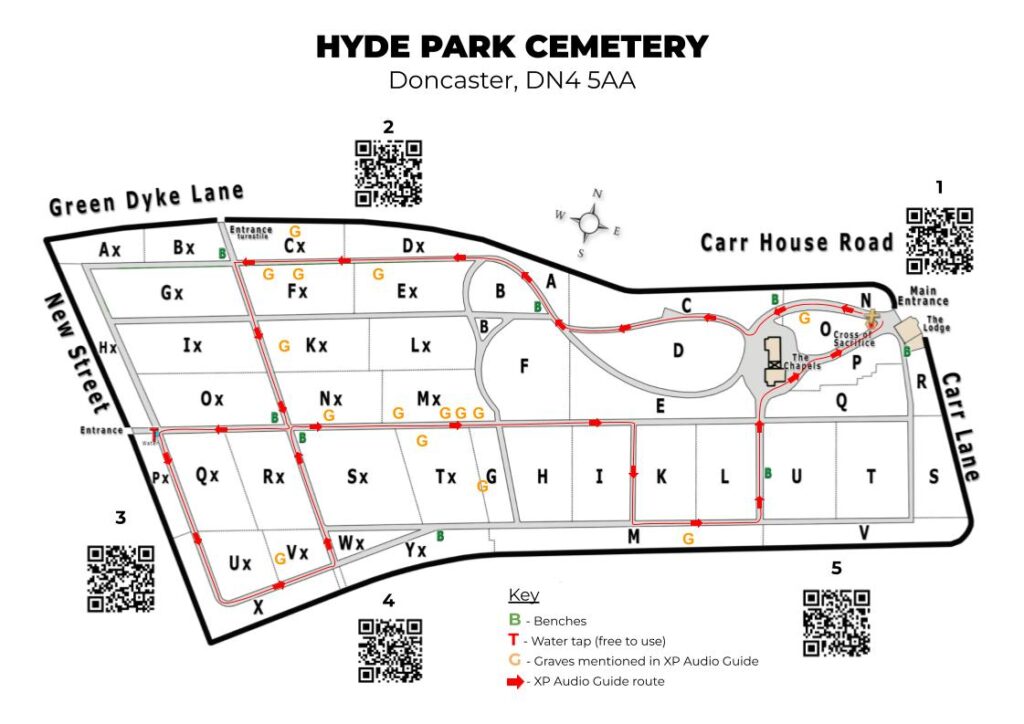
We would like to give you a big hello and welcome from C31 to a self-guided audio walk around Hyde Park Cemetery. This is our final product in the second expedition at XP and we wanted to show it at the cemetery to remember the soldiers who fought for freedom. Welcome to Dig Deep and your guiding question for today is why is it important to have shared solidarity for survival? Hyde Park Cemetery is located near Bourby Road on the left side and next to a glass and window shop.
The construction of Hyde Park Cemetery took place on the 1st of January 1856 which means one of the oldest graves there is chambered January 2nd. The cemetery has been here since 1856 and opened on the 1st of January. People here have been buried here since World War I and many of the soldiers have tragic endings.
Did you know that many of the striking features in the cemetery you see today were made by a keen royal gardener, Queen Caroline, wife of King George II. This cemetery in particular has 82 Commonwealth burials from the First World War and 26 from the second. One of the key people buried here is George Thomas Tubby.
He was born in 1857 and died April 16th 1932. He was famous for being in the photo which was across Yorkshire and he also brought affairs to Yorkshire. He was the founder of Hyde Park Cemetery.
At this place we must remember that we are here to show respect to the land as it is a cemetery and people are buried here. So young children must be close to a respected guardian at all times. Here lies Arthur Skinner, a trooper in World War II.
He was born on the 28th of January 1909. He joined the army at 29 and died at 55. According to his brother he was living in Old Malton although he had previously lived with him at Carhouse Round.
In 1939 he was shown living there working as a joiner labourer before he joined the army. Arthur Skinner when in training for the army he managed to escape the camp and was absent without authorised leave. He returned back to Doncaster and efforts made to get him back to base by car were unsuccessful but he said he would give himself up later that day only after an appointment that he had to keep.
Before Arthur Skinner conscripted into the Royal Armed Corps as a trooper in World War II his family had expressed concerns about his mental state and they thought that the army was too heavy for him. Arthur Skinner is mostly recognised for Gotham running quest that was held and a verdict was given of suicide by the balance of his mind was disturbed. He contributed to the war, his title was private and also fought for his country as a trooper during World War II although his family didn’t like it.
Arthur Skinner was a brave man because he fought for our country and he also saved many lives while he was doing his bit in the army. The Commonwealth War Graves Commission is a global organisation caring for 23,000 graves locations in more than 150 countries and territories. They clarify on almost 1.7 million individuals.
The CWGC Graves Commission has a duty to ensure sites are kept neat and tidy. They also create information centres, volunteering opportunities and education programmes designed to engage and educate generations to come. The crucial decision about the headstones was that they should all have a uniform appearance which is around the top.
Each headstone is inscribed with the details of the individual name, award, service number and a personal inscription provided by the family. You will likely see a regiment crest or badge at the top of each headstone. As you walk into the Hyde Park Cemetery you are met by a long and high cross designed in 1918 by Sir Reginald Blomfield.
The cross is known as the Cross of Sacrifice. This represents the importance that the soldiers had in World War I. The Commission thought there should be some kind of committive focal point in each grave together as one shared sacrifice. Commonwealth War Graves are important so that we honour those who died during World War I. The War Graves paid tribute to those who served in the Commonwealth Forces and made the ultimate sacrifice in World War I.
Franz Ferdinand was born into an old European family. He was heir to the throne for Austria-Hungary. At the age of 12 years old he began his military career and he successfully moved up the ranks. Franz Ferdinand was in Bosnia and Herzegovina with his wife in an open top car.
Even though Franz Ferdinand was aware of the Black Hand Gang he ignored them. The Black Hand Gang consisted of seven members. They were positioned in the crowd and a member of the Black Hand Gang saw the open top car and threw a grenade and bounced off the car with the Archduke and his wife.
The woman rolled backwards and exploded the car behind causing unrest to break out in the crowd. Franz Ferdinand was seen as a threat to Serbian independence and so the Black Hand Gang wanted to assassinate him. On June 28th 1914 a man called Gavrilo Punicic shot and killed Franz Ferdinand and this was a spark that caused the First World War.
Sir Thomas Barclay of England predicted the danger of war in Central Europe. If Serbia failed to meet the demands of Austria-Hungary their army was going to invade Serbia. They listened but wanted to investigate the murder themselves.
Austria-Hungary did not agree with this and on 28th July 1914 declared war on Serbia. Militarism, one of the four main causes of World War I, was a key factor to the start of the war. Militarism is when a country takes pride in its armed forces and spends money on an arms race with other countries.
Countries such as Britain and Germany also fought in a naval arms race. During the arms race they made battleships to increase their naval power. Both of the countries had a lot of money to make weaponry but other countries also wanted to make their navy bigger so they could win the war.
Militarism caused fear and tension amongst countries when a naval arms race broke out between Britain and Germany in 1906. Each country was spending millions of pounds on ships and submarines to try and be better than the other. Although militarism created lots of fear it also helped countries to be able to develop weaponry and battleships which helped Britain to win the war.
Countries still build powerful militaries so learning about militarism helps us understand how tension brings conflict. Alliances. The second cause of World War I. The alliances when two or more countries come together in an agreement to help each other if needed.
For example the triple entente which was established in 1914 between France, Britain and Russia and the triple alliance which was established in 1882 between Germany, Austria-Hungary and Italy. These alliances provide each country with support to be able to grow and develop. This is because if a country was in danger they could help each other for example when Serbia called on Russia and Austria-Hungary called on Germany which led to the breakout of World War I.
Alliances were thought to promote peace because everyone had support however other countries would feel left out from alliances which would then cause tension.
This combined with the geography of Europe with Germany in the middle of France, Russia and Great Britain, the triple alliance which heightened suspicion of other nations which ultimately led to conflict. The triple alliance was also the closest to the ocean which means they could escape quickly. Countries can be pulled into a conflict due to being in an alliance for example the assassination of Franz Ferdinand.
Britain ended up involved in World War I because Serbia called on Russia and because Britain is in an alliance with Russia and France, Britain was called in by Russia. Alliances prevented local war between two countries instead of creating world wars and getting more people in danger. There are lots of things we can learn from alliances and promises that countries make to each other.
Alliances are good because countries can help each other when needed though they are also incredibly toxic and as was the case for World War I can cause mass devastation.
Imperialism means to take over other countries and place them under your rule. This creates an empire, a large group of countries controlled by one single country or ruler in this case Great Britain.
At the time Britain through imperialism had created an empire which spanned a quarter of the world’s map. Countries compete in war because they want to prove that they can be greater, more wealthier and powerful. They also want to make bigger troops to persuade others that they are the best of all the empires.
This creates tension and rivalry. Though imperialism sounds unifying, groups of countries working together wasn’t as straightforward as that. Imperialism led to disputes over land because countries wanted more land in order to make them their strongest empire.
When countries feel threatened or angry they would get to work by starting to build an empire or an army so they could intimidate any opposition. Problems arose when two countries wanted the same piece of land or when faced with resistance. Because countries protect their land and show the empire what they can do, empires responded with military forces leading to long-term conflict because people didn’t want to follow the rules that were set.
Understanding imperialism helps us see why countries need to respect other nations, independence and resources.
Nationalism is one of the four main causes of World War I. Nationalism is when someone has strong beliefs for their country. These beliefs include thinking that no other race or religion deserves the same rights as them.
Countries also believe they are the best and undefeatable. It can be carried out by communities, members of the public and governments when they want to influence a sense of pride to surrounding areas and can be done in multiple different ways which was evident throughout World War I from soldiers.
Nationalism leads to tension and conflict between the two countries as they have both been taught to believe they are superior. When both countries are told this, each wants to show they are the strongest. This can lead to rivalries and in the case of World War I.
Nationalism can make people want their own nation-state as they believe they are entitled to self-rule. This leads to attempts to expand their land and power.
This can be done through petitions, riots, rebellion and even wars of independence. Takeover of land caused disagreements between the countries which is a reason for nationalism. Nationalism can be shown in all wars because people protect their country and land.
Nationalism still starts conflicts in war today. Do you think nationalism has more of a positive or a negative effect in war?
The British government was divided over Britain’s potential involvement in war since they wanted to protect their empire. On the 2nd of August 1940, Britain’s cabinet agreed to support Belgium.
Britain made a treaty to keep Belgium neutral in the years leading up. On July 24th 1914, two British foreign secretaries tried to organise a peace conference to stop war escalating but Germany refused to attend. From the 1st of August, Britain mobilised the navy to protect the French coast to ensure Britain’s security and trade was not threatened.
Britain gave Germany an ultimatum to leave Belgium. Germany did not respond. As the deadline approached, large crowds gathered at the front of Buckingham Palace to see their king George V. At 11pm on the 4th of August, war was declared by Great Britain on Germany.
The crowd cheered and the national anthem was sung by the crowds. People were excited by the thought of war yet there was a sense of anxiety. People initially expected the war to be over quickly as the public thought it would be a quick fight.
As time went on, the soldiers and their families at home realised it was a lot more serious.
Bravery In The Ranks
Private Matthew Rhodes was a corporation schoolboy prior to the war. He decided to join the war in May 1915 at the age of 19. Matthew was in the trenches for a few months but unfortunately got wounded and sent back to England. He then died on the 20th November 1921 at the age of 25, which was two weeks after being discharged from the Sheffield Hospital. Matthew was a part of the Royal Defence Corps in the First World War. He was discharged shortly prior to the armistice, the ceasefire that ended hostilities later in the war while serving in York and Lancers. He was wounded once again and had to leave his wife and baby behind. His role was significant to the war because he was in the Royal Defence Corps which provides troops for security and guard duties for the United Kingdom. These contribute to protecting the coast and the skies. Unfortunately, 12 months before he died, he got married and had a baby. Having served almost the whole war, he rarely got to see his family and child before his death. Matthew Rhodes’s contribution was important because he helped to get troops out of the trenches and into safety while also protecting the coast and skies. In doing this, he gave his life to Great Britain. There are some graves here in Hyde Park. They’re from soldiers who served on the HMS Curacao.
The HMS Curacao was a C-class light cruiser with anti-air gun capabilities. It was launched from Pembroke Royal Dockyard on the 5th of May 1917. It was made to protect and escort British goods across the seas and from German ships and aircraft. The HMS Curacao did have a serving soldier aboard from Doncaster. His name was John Charles Clifford Ripley. He was the son of James Howard and Sarah Ann Ripley. Of 68 cardiannual, born in Doncaster, he was 24 years old when he died. Ripley John Charles joined the Navy as an engine room artificer 3rd class. This is a specialised position in the crews of the Royal Navy. An engine room artificer would usually have to be fitter and stronger to be a boilerman, coppersmith or enginesmith aboard the ship. He was buried here in Hyde Park Cemetery in 1918. At the location of his grave there’s a large cross where poppies can be laid. The HMS Curacao was important because it was escorting thousands of US troops on the Queen Mary.
In August 1914, Hyde had joined the 6th York and Lanchester Regiment after his previous job of being a fireman at age 26. He trained at Belton Park undergoing intense physical demands alongside weaponry practice and some time after he was sent to Gallipoli where he performed a landing at Southwell Bay in August 1915. When he was transferred to Egypt he was affected by tripod fever and dysentery which made him unwell and unable to fight. With some resting he was able to serve again. This shows that he really felt belonged and a part of something. As a member of the infantry, Hynde’s role was important in the war because the infantry became a primary force for taking and holding grounds on a battlefield as an element of combined arms. He died as a result of the battle on the 27th of February 1919. George Henry Hynde’s contribution to the war was important because he left his family to join the infantry with guns to bring protection. He also sacrificed his life for his country.
Alan Alexander Payne was a World War I air mechanic who was born in 1888 and died in 1916. He rose as a carpenter and was married with one child. Their son was born four months before Britain went to war. Alan joined the 15th reserve squadron that was based on Thetford and became an air mechanic first class for the Royal Flying Corps. During his time as a part of the Royal Flying Corps he piloted BE-2CS. They were reconnaissance planes but could also be modified into bomber planes. Alan was a pilot and air mechanic. He worked on repairing planes and also piloted aircraft used for reconnaissance. His efforts helped gather intelligence on Germany contributing to the war effort. Alan was brought to the cemetery by motor ambulance and the dead march was played on the way from the infirmary. Although we have yet to find when and how Alan Payne was injured, we know that he was treated for a perforated gastric ulcer and tuberculosis at the Doncaster infirmary prior to his death and succumbed to illness on Monday 26th June 1916 at age 28. His funeral was given full military honours with a Union Jack covering the coffin. The infant was treated to a firing party and the last post was sounded at the conclusion of the ceremony.
Private Cyril Laycock Squire was born in Hunslet, Leeds and was employed as a telegraph messenger on the Great Northern Railway. After being trained as a signalman he worked at Ingersby, Leicester, Badderton near Newark and at Bentley Crossing in Doncaster. In 1910 he enlisted in the York and Lancaster Regiment and as the war broke out he served in India. He was sent to France in the early stages of the war and was wounded in his left hand which necessitated his removal to a Nottingham hospital. He returned to France once again though later suffered an injury to the lung. Upon returning home he suffered bad health and the illness which proved to be fatal had confined him to bed for around three months. He died from tuberculosis at 27 years old leaving a widow, Beatrice, and two children. When he died his coffin was covered with the Union Jack and at the close of the service the last post was sounded. He represented the Comrades Club so when he died a majority of his fellow signalmen from the club attended the funeral. Private Cyril Laycock-Skyer has been a huge inspiration and has done a lot to protect us.
The Corps of the Royal Engineers was officially formed in 1716. Its purpose was to provide the British Army with vital engineers and technical support. This became especially important during major conflicts such as World War I where skilled engineers were essential on the battlefield. The Royal School of Military Engineering, which serves as the training centre for the British Army engineers, is a key part of the Royal Engineers. While the main base is located in Chatham, the influence of the Royal Engineers extends across the UK including places like Doncaster. One notable connection to Doncaster is the story of James Woyle, a local man who served with the Royal Engineers during World War I. He was born in 1894 and tragically died in 1917 at the age of 23. He is buried in Hyde Park Cemetery and remembered for his service. Several individuals from the Royal Engineers played significant roles during and after the war, including Jonathan Davies, George Amos Hyder and Horace Storey. These individuals are remembered for their bravery, service and contributions to the Corps. World War I had a huge impact on the Royal Engineers. The Corps lost a total of 9,852 men during the war. Memorial cemeteries and personal stories like those of James Woyle, George Amos Hyder and Horace Storey help us remember the sacrifices they made. Their service continues to be honoured in both national memorials and local sites like Hyde Park Cemetery, keeping their memory alive for future generations.
Harry Axel was born in Doncaster in 1898. He lived with his parents in Wheatley and had six siblings. He died at the age of 17 when he caught pneumonia. Private Harry Axel served on the ship Yorkshire Dragoons Queen’s Own. His service number was 3839. The Queen’s Own Yorkshire Dragoons was a regiment of the British Army which existed from 1794 to 1956. Soldiers who served in this regiment were highly trained, operating ahead of other forces, monitoring enemy troops and feeding intelligence back to commanders. They used advanced weaponry, thermal imaging equipment, and digital battlefield communication systems. Harry joined his camp in September 1915 at the age of 16. He was there for one year when all the training and lack of sleep led to his death. The Yorkshire Dragoons were involved in the Battle of the Somme. When Harry died he was buried with four military honours. In 2017, Doncaster Minister raised funding to restore the World War I Memorial to the King’s Own Yorkshire Dragoons, which contains all the names of those who tragically lost their lives during the war, including Harry. He was hailed a hero in the local newspaper, which also wrote a poem honoring him and the rest of the fallen soldiers.
Empires At War
The Suffolk Regiment was formed in 1685 as a result of King James II ordering Henry Howard, the 7th Duke of Norfolk, to raise a regiment. Over the centuries, the regiment participated in numerous key battles earning significant honours. Some of the most notable battles included the Battle of Dittingen in 1743 and the Battle of Mindon. However, it was during World War I that the regiment expanded quickly, growing to 23 battalions and playing an important role in the war effort. The Suffolk Regiment recruited men from Doncaster, although they were not specifically designated there. The Suffolk Regiment was stationed and established in Bury St Edmunds.
While the regiment was primarily stationed and established in Bury St Edmunds, there were links to Doncaster through recruitment and service during World War I. Many soldiers from Doncaster enlisted and served bravely under the Suffolk Regiment’s banner. Private Percy Bedstead, who was known in the Suffolk Regiment, served in the First World War. Throughout Suffolk, there are many memorials dedicated to those that took place and fell through the war.
The Suffolk Regiment played a major part in World War I, expanding greatly over the years. The government soon realised that there weren’t enough men who volunteered to join the army, so they used propaganda as a way of recruiting more men. Lord Kitchener’s propaganda campaign encouraged over one million men to enlist by January 1915.
The use of propaganda promoted the need to join the war. The men who enlisted were 18 to 41 years old and were usually single. The youngest recruit was aged 12, but was later discharged at age 13 after proof of his real age was given.
Trenches were an efficient way to protect the soldiers from the heavy firepower and shelling. They would usually consist of construction sandbags, wooden planks, woven sticks, barbed wire and mud. The muddy, uncomfortable and smelly conditions of the trenches could lead to trench foot, which, if left untreated, might require a soldier’s foot to be amputated.
In the four years that the war took place, 22 million people died and 23 million were injured. The most common illness was shell shock, which is now known as post-traumatic stress disorder. There were also long-lasting effects felt for many years after the war ended.
Propaganda was used during World War One to make people think in a certain way about what was happening and to gain support to help fight and win the war. The British shared stories about bad things the Germans had done. This was done to make people want Britain to defeat them in war.
In addition, Germany told similar stories about Britain. Within a year of Great Britain’s declaring war on Germany in August 1940, it had become obvious that it was not possible to continue fighting by relying on voluntary recruits. Propaganda posters were used to raise troops and the government needed lots of soldiers.
They were designed to persuade men to want to join the army and do their bit. However, these posters were biassed or misleading and were used to promote a country’s political cause or point of view, in this case World War One. Unfortunately, even Lord Kitchener’s campaign was not enough to keep pace with increasing casualties.
In January 1916, the government saw no alternative but to increase numbers by conscription, which was compulsory active service. Without it, the French army would collapse and the war would be lost. An empire is a group of countries ruled over by a single monarch or ruling power.
The mother country and the colonies are countries ruled by some degree by Britain. The British began to set up overseas colonies in the 16th century. From these beginnings, the British empire grew and grew.
In 1924, the empire was at its height. It was the largest empire in history and contained around 450 million people, approximately one quarter of the world’s population and covered 40 million square miles, about one quarter of the earth’s total surrounding area. These colonies would provide England with valuable materials like sugar, which they can also sell to other countries.
But as the empire grew, the more ambitious the empire became. They also offered money-making opportunities for the wealth of the English as they provided England poor and unemployed. And as the empire grew, the more ambitious it became.
The Germans were envious about Britain’s empire and its efficiency and power. They wanted an empire which was bigger, more wealthy and powerful. We are going to be explaining why the Indians were so important to World War I and how they played a massive role.
India was located in the north of the equator where it has a latitude greater than zero degrees. The Indians were so important because they were named the jewel in the crown because of its location, resources and population out of which they could earn amounts of money. India was also a major source of human and other resources because the British had 1.3 million servicemen that fought in World War I that had 70,000 fatalities.
Britain started to colonise India from 1757. Britain increased its control of India through the East India Company. From 1858 onwards, the British government directly ruled India and it became the British Raj.
Today, Sikh is one of the most recently founded major religions and is among the largest religions in the world with about 20 to 30 million followers. The Indian religion, which originated in the Punjab region, started in 1469-1539 by Guru Nanak. Sikhs believe in one God, Warri Guru.
In the religion, Sikhs wear the five Ks to show they have dedicated themselves to a life of devotion. Most importantly, Sikhi is a spiritual faithfulness where they believe in ten Gurus. Sikh soldiers believe in a concept of the just war, meaning war in the defence of righteousness.
They believe that war must be the last resort and must not be revenge. They also believe that the army must be disciplined and that civilians must not be harmed during the war. Sikh soldiers who followed the teachings of the just war concept during World War I believed places of honour and worship of any faith should not be damaged or any soldiers that surrendered must not be hurt.
Life in the trenches was really tough as India is a very hot country, so over time they got used to the heat. When they found out they had to fight a war in France, they soon found out moving, shouting and fighting would be difficult as these were not the weather conditions that they were used to. The British government helped the Sikh soldiers by substituting tents for Gurdwaras.
Every care was made to make sure they could practise their religion even on the front line. During the First World War, Sikh soldiers showed a deep commitment to fighting but sacrificed themselves in battle as political and religious duty. 100,000 men fought in World War I but just under 8,000 Sikh soldiers were sacrificed.
The Royal Army Service Corps was formed by the CTC and War Department merging together and creating a new form of the Army Service Corps. The job of the RIC is to efficiently deliver food and equipment to the front line. The regiment recruited soldiers from Doncaster and across many states including the Commonwealth.
The regiment also trained soldiers in some shooting places to be experienced and defend better. Although many soldiers that had been chosen to participate in the events of the World War had been trained for it, there were some notable Doncaster soldiers that served. Britain was known for contributing to the recruitment process in World War I by having a group of friends or people to be recruited to the war so they could get more soldiers quicker and easier.
The trenches were filled with poisonous gases and bad smells and it was almost impossible to sleep and try and stay alive without having terror. They also had many diseases and this lasted for a long period of time since World War I lasted four years. As soon as World War I ended there were over 100,000 memorials of soldiers.
Most of these memorials have been buried in a cemetery called Hyde Park Cemetery. It is important to remember the regiment’s role in World War I since they have played a vital part in helping recruit and train even more soldiers. Private William C Grey lived from 1877 to 1950.
He was born in Edinburgh but lived in Hull for some time before moving to Doncaster where he was employed as a medical practitioner. At the time of his death he was serving in the 5th Battalion West Yorkshire Regiment. He along with his comrades had been on guard duty since the outbreak of war and went on sentry duty from time to time at St. Delaney Bridge.
He was off duty at the time of the accident. On the 25th of May 1915 he was carrying a bucket of rubbish to a farm whilst walking along a railway line close to the sleepers when he was struck by the 4 past 10 train from Doncaster to Hull and killed instantly. Private Walter Kirk who was on duty at the time reported that he had seen the train coming and tried to warn Grey but he did not hear him.
Assistance was summoned but William was pronounced dead at the scene. The coroner found no blame attached to the driver and the verdict of an accidental death was recorded. He was later buried here in Hyde Park Cemetery in a Commonwealth war grave to remember him and his effort in the war. About 80 men from the 5th Battalion attended his funeral. In Hyde Park Cemetery there are many Commonwealth graves. One of the key regiments that are commemorated here is the Canadian General and the 85th Battalion Regiment.
The Canadian forces were formed in September 1915. It was formed in 1915 because they needed more troops for the war. A key contribution that the Canadian forces made in World War I was the Battle of Hill 70.
This battle lasted from August the 15th to 25th 1917 which cost the Canadian forces 10,000 men who were wounded, killed or missing from action. There are many soldiers from the Canadian forces laid to rest in this part of Hyde Park Cemetery. One of the soldiers who was treated in Doncaster was Edward Mulving.
In June 1916 Teddy was admitted to Doncaster hospital for a crushed back and chest injuries he had gained from supporting the Commonwealth forces. He was nursed back to health by a nurse named Julia who was thanked by Teddy’s mother Celia in a heartwarming letter. Teddy spent 153 days in the hospital November 16th not to go home but to return to the front lines.
Teddy remained in touch with Julia while she served, sending postcards, letters and photographs holding Julia in his heart for the kindness and compassion she showed him. Every soldier that fought in the Canadian forces in World War I they all have the maple leaf on their grave as it is important that people can see the symbol to know that they sacrificed their lives and fought in World War I. We think it is important to remember the Canadian forces as they made a huge impact in the war effort.
Heroes of The Skies and Trenches
Thomas William Booth was born in Doncaster in 1882. In 1904 he married a woman called Neil and they had five children from 1904 to 1913. Before the war Thomas worked for the Plant Works, a Doncaster company which made lots of weapons in World War I. He joined the war in France on May 31st 1915 as a corporal in the D Company.
He was posted to the 6th Battalion of the King’s Own Yorkshire Light Infantry. Thomas was moved to an advanced dressing station and a casualty clearing station which had medical facilities for seriously wounded soldiers receiving treatments. On the day that he died he was asked to repair telephone wires that had been caught by shell fire, a perennial problem.
The party got chilled causing two men to suffer serious injuries and unfortunately he was one of them. Thomas later died on 19th July 1915 at age 39 from serious injuries. We are grateful for Thomas William Booth’s contribution to the war as he made weapons for soldiers to fight in World War I and supported the UK in war.
Whilst looking at the historic war graves look out for the courageous men who were in the iconic Royal Air Force. The RAF was formed on the 1st of April 1918 and strafed enemy trenches and bombed airfields and industrial facilities. In these various roles the RAF took part in nearly all the major battles of the First World War and served in all the main theatres.
During the First World War the RAF were based on the racecourse when they relocated to Anastrup in Finningley and then changed to a newly built site in 1916. Members of the RAF were stationed and trained here at Doncaster during the war. A notable person who saved the RAF during the war is HL Savage who is buried here at Hyde Park Cemetery.
Another man who served was CL Crowcraft. He was a white operator, aircraft man and a gunner. He was also buried here at Hyde Park.
We remember the RAF because it served a big purpose in the war. This means that it was needed and it will always be known as important and significant. Sergeant Vivian was born in 1881 in Chiswick, Middlesex.
He lived with his family Edith Vivian and Richard Vivian. To begin his career he made a debut as an electrical engineer at 19. Vivian was trained to be a soldier to support and take part in his country.
He went to train with the training squadron which was a type of depot station. It had been said that his service number was 3537. As a member of the RAF he learned how to shoot and fly planes.
It was important because he was the first offensive outlander. However on the 15th of October 1918 aged just 26 he tragically died due to a horrific accident where he was shot with a type of gun called a variety pistol which was another word for a flare gun. His death was purported to be right here in Doncaster.
Private William Jones was aged 27 when he joined the war. Jones was born into a respected family in Bulby who lived on Carr Hill, Doncaster not far from where you stand now. He served in the army for Great Britain fighting at the Western Front.
He belonged to Yorkship, Lanchester. William joined the war with his rank that shows a soldier’s level of responsibility, expertise and authority. Jones was a talkative man with a passion to bring victory to the country.
Private William served in the military until his death only 18 months into the war at North Staffordshire Hospital, nine weeks after his treatment. Even though he was buried with full military honours and a ceremony performed by soldiers to remember somebody important, he did not receive any awards. The story of Private Jones is one of many other soldiers that fought in the war for Britain.
Looking around Doncaster, Private William would have seen everything you have. He then went to give up his life for the town and our future.
George William Slack is known as Charles Thomas Holt. He died at the age of 34 in a plane crash in the year 1918. George was born in Jesuit Newcastle and served under the name Charles Thomas Holt. George William Slack was two years old when his adoptive parents changed his name to Charles Thomas Holt so it was believed that he did not remember his original name.
Charles Thomas Holt was an RAF pilot in World War One. Supposedly people say that their plane engine failed and the pilot attempted to turn back but he got into an accident and crashed. It was assumed that the incident occurred only moments after takeoff.
Charles Thomas Holt was a brave man who fought for his country. To honour him we need to remember what he did for us.
This grave belongs to one Anthony Caldwell of the Royal Flying Corps. He died aged 26 in a downward spinning nosedive. There was one other man in the plane with him, 2nd Lieutenant Siren Harvey Trollope. They both died while participating in a height record tournament at Doncaster.
Anthony was in the unit of Officers Cadet Battalion and his role in the military was 3rd Air Mechanic. He also joined South Farnborough. He was the first to be transferred to a more advanced squadron.
The Officers Cadet Battalion had an establishment of 400 cadets at one time. Formed in 1912, the Royal Flying Corps consisted of a military and naval wing. Early on in the war the Royal Flying Corps’ main jobs were artillery spotting and photographic reconnaissance.
This eventually led them into battles with enemy aircraft. Fighter squadrons were soon formed to protect the observation aircraft and engage enemy planes. Soon the RFC would be bombing German airfields and trenches. They also served in all main fronts of the war.
Anthony signed up for the RFC in 1916 and was discharged in 1917. During this time he was appointed 3rd Air Mechanic of the Officers Cadet Battalion. Up until May 1917 he served with many squadrons when he joined the number 15 squadron and was temporarily appointed 2nd Lieutenant.
Anthony Still Cardwell’s role in war was as a mechanic and fixing the RFC biplanes. The accident that Anthony had had an investigation afterwards. He paid his own fare and sailed to England to join the RFC. He was buried with full military honours and received recognition from the Commonwealth War Graves.
Anthony Still Cardwell was a very kind and intelligent man who accomplished a great deal in his 26 years of life. We thank him for his contributions.
Jacob Lipinski, also known as John, was born on the 23rd of January 1895 in Nikolovia, Russia. Jacob was Jewish and being in a Jewish family in Russia was increasingly difficult as Russia had banned Russian Empire Jews from living east of the Dnieper River. Life as a Russian Jew was tough.
Jacob joined the University of Glasgow in 1913. In his first year Jacob took classes in chemistry, natural philosophy, maths and a physics laboratory class. On his way to graduating he put his studies on hold to join the Royal Flying Corps on the 13th of November 1917 and was made a temporary 2nd Lieutenant of the Royal Flying Corps.
As a new recruit Jacob had received very little training. He went from practising in a wooden impersonation of a plane to flying the real thing in a really short period of time.
On the 5th of February 1918 Jacob’s plane struck a ditch and overturned in a field near Leehamel. Shortly after joining the Royal Air Force on the 7th of March 1918, Jacob’s plane overshot the landing and ran into another plane.
In June of 1918 his plane landed heavily before being bombed and in July of 1918 he was wounded by the enemy and taken as a prisoner of war. Jacob was sent back to Britain in December 1918 where he settled. He stayed with the RAF and did not return to university.
On the 26th of July 1919 he attended a RAF open day in Doncaster and tragically died when trying to start a colleague’s plane propeller. He was struck on the head with the propeller and instantly killed. We are grateful for Jacob’s contribution to the war and saddened that he did not get to show his full potential.
Private Charles Gilvray, son of Sarah Ann Gilvray and William Henry Gilvray, was a soldier in World War One. Charles was born in Doncaster in 1885. He died aged 28 on the 7th of November 1914.
Before the war he worked as a blacksmith striker and joined the army at the age of 21. He joined the war as a private as part of the York and Lancaster Regiment 2nd Battalion in France.
He was in the trenches for eight days and was captured by the Germans. Charles Gilvray escaped but was wounded by a bullet to the head in the process. On the day he died he had been transferred to Selwyn General Hospital in Oxford where he died from his injuries.
We are grateful for Charles’s contribution to the war as without men like him, we would not be where we are today.
Service And Sacrifice
The Lee-Enfield served as the main firearm for the military forces of the British Empire and Commonwealth. The Lee-Enfield was a standard service rifle. Just picture yourself in the trenches of World War I, rifle in hand, allowing the Lee-Enfield to lead you to victory. If you were wondering, it weighed 9.06 pounds (4.11 kilograms) and was 44.5 inches (111.6 centimetres) long. Could you imagine carrying the Lee-Enfield all day long?
The flare gun is a pistol for firing flares, commonly used with whistles for ordering soldiers out of their trenches. The most feared weapon in World War I was the German flamethrower. Men were consumed alive by sheets of fire as the trenches filled with red hot death. They would scramble out of their trenches. Unlike the ‘land ships’ (tanks), the flamethrower of World War I was spearheaded by the Germans in both development and application. The improved fuels added to the flamethrower had doubled the weapon’s firing range by about 20 to 40 yards. This proved to be an effective tool against strongholds and trenches. Although effective in killing large numbers of people, the flamethrower could be considered a safer or more powerful weapon for the operator due to never needing to step foot onto the front line.
Weaponry was used at long range in the 19th century. Weaponry was designed to kill from a distance and cause significantly more damage than the usual hand-to-hand combat. The mortar was a trench weapon and was invented by Sir Wilfred Stokes. It could fire up to 800 metres and at a faster rate than the Germans’ models, which were called the Minenwerfer. But could you imagine being in a cold and wet, muddy trench infested with rats during a bombardment overhead? Mortar absorbs water over time, which would make the weapon even heavier.
In 1800, the British Army formed the Rifle Brigade, transforming warfare with rifles, mobility, and marksmanship. The Rifle Brigade excelled in World War I battles like the Somme and Amiens, using precision and adaptability to help break German lines and secure Allied victory. The Rifle Brigade recruited soldiers from Doncaster, a key source of troops from the UK’s industrial and working-class communities, supplying fighters in peace and war. The Rifle Brigade was stationed and trained at several locations, including Basingstoke, Nettley, Aldershot, and Whittington Barracks, with overseas postings in places like India and Gibraltar. Private William Thomas Anderson, a soldier from Doncaster, served in the Rifle Brigade and was awarded the Victoria Cross for his bravery during the Second Boer War. William, of the 4th Australian Pioneer Battalion, died on September 11th, 1916, at the age of 18. Though not memorialised at Hyde Park Cemetery, he rests in France and will always be honoured for his sacrifice and courage. Doncaster’s war memorial in Sir Nigel Gresley Square honours soldiers from various conflicts, including those in the Rifle Brigade, as a key site of remembrance. It’s important to remember the Rifle Brigade’s bravery, skill, and resilience in the World War, highlighting the vital role of infantry in the Allied victory.
During World War I, women took on most of the men’s roles, which included manufacturing, agriculture, flying planes, treating patients, organising fundraisers, and much more. During the war, women became a lot more involved in the outside world instead of just being confined to the home looking after the kids and cleaning the house. If women hadn’t taken on the men’s roles, resources would have been very limited and it would have been harder for the men at war. In the munition plants, women made bombs, guns, bullets, and more. It was dangerous, as they worked around chemicals with limited protection and worked long hours with little breaks. Doncaster helped with making munitions and sending over resources.
Women working in the VAD (Voluntary Aid Detachment) carried out duties that were less technical but still as important as fully qualified nurses’ work. Women would also be given training as physicians and dentists. Many others worked in the convalescent homes that were set up to look after wounded soldiers in World War I. There are no nurses or VAD workers buried in Hyde Park Cemetery, although there is a special nurses’ plot in Brookwood Cemetery in the UK. The Representation of the People Act, which was brought in at the start of 1918, is believed by some historians to have been a result of the contribution women had made to the war effort. Women would have been a familiar sight to people of Doncaster. Women undertook jobs normally carried out by men and proved they could do the work just as well. To remember the contributions of women in war today, we can celebrate their lives and the time they dedicated to their duty.
The Duke of Wellington’s Regiment was formed in 1881. Hyde Park Cemetery contains the graves of soldiers from many different regiments. In the Great War, it was deployed in Ireland and then moved to the Western Front. The Duke of Wellington’s Regiment, also known as the West Riding Regiment, was one of Britain’s most respected infantry regiments. It recruited soldiers from Yorkshire, including Doncaster, and played a crucial role in World War I. Today, we’ll explore the regiment’s connections to Doncaster and remember the brave men who served, including Corporal Cyril Ledger and Private James Oldham, both buried here in Hyde Park Cemetery. As you walk through Hyde Park Cemetery looking at the Commonwealth War Graves, among them you’ll find soldiers who served in the Duke of Wellington’s Regiment.
While the regiment didn’t have a permanent base in Doncaster, many local soldiers joined in Yorkshire before being sent to the Front. Cyril Ledger was born in Doncaster in 1897. He joined the West Riding Regiment of the Duke of Wellington’s and served on the Western Front. By July 1918, as the war was nearing its final months, he was tragically killed in action at just 21 years old. His sacrifice is honoured with a Commonwealth War Graves headstone here in Hyde Park Cemetery, a reminder of the cost of the war. Another Doncaster man who served in the Duke of Wellington’s Regiment was Private James Alston, who enlisted under the name Alton. He too is buried here in Hyde Park Cemetery. While less is known about his exact service, his burial here ensures that his story is not forgotten. Like many others, he left his home briefly and never returned. The Duke of Wellington’s Regiment was known for its courage and resilience, and Doncaster’s sons were part of that legacy. Corporal Cyril Ledger, Private James Alston Oldham, and many others gave their lives during World War I. Their names may fade from memory, but their sacrifice will always be honoured here at Hyde Park Cemetery.
Have you ever considered the role animals played in the war, or do you just think of soldiers? Horses played a significant role. A staggering 3.6 million horses were used in the war to carry out a variety of roles, including carrying injured soldiers, transporting soldiers, food supplies, equipment, guns, and ammunition. This served to save soldiers time and energy. Warrior was a war horse who took part in the First World War. He had an amazing impact in the war but sadly passed away from health issues. Stories such as Warrior’s serve to remind us of animals’ contributions to war efforts, which were not always recognised.
Dogs were used in World War I for many reasons. They could find injured soldiers and warn people of gas attacks. Dogs also served as messengers, saving countless lives by warning of incoming attacks. Sergeant Stubby, a Boston Terrier, warned his regiment of a gas attack; though he was affected by the gas, he had to use a gas mask. Sergeant Stubby was also good at finding and locating soldiers on the battlefield. He found injured soldiers and allegedly caught German spies. Sergeant Stubby became notable for his heroics on the battlefield during World War I. At the age of one year old, Stubby was sent off to the battlefield in the trenches in France. Stubby’s first ever award was the Gold Medal after finding and capturing a German spy. He also got the award of a Purple Heart for finding an English soldier on the battlefield and was made Sergeant after he helped to capture an enemy spy in the Yankee Division. He is also the mascot for the Georgetown Hoyas. Sergeant Stubby proved extremely helpful locating wounded soldiers and learned how to salute by raising his right paw towards his face. Stubby’s contribution was notable because he saved over 1,000 lives.
Born from war, the South Irish Horse was formed in 1902 as an Imperial Yeomanry regiment, continuing a unit from the Second Boer War. The South Irish Horse provided reconnaissance and support in key World War I battles, playing a vital role in breakthroughs before being disbanded in 1922 after Ireland’s independence. The South Irish Horse was primarily recruited in Ireland, but during World War I, some soldiers from Doncaster may have been assigned or transferred to the regiment. The South Irish Horse trained at the Curragh Camp and, with Doncaster’s strong military tradition, recruited soldiers for its prestigious cavalry unit. While the South Irish Horse included soldiers from across England, specific individuals from Doncaster are not permanently highlighted in historical records. The South Irish Horse gained recognition in World War I, especially in the Middle East and Palestine, for its cavalry charges and reconnaissance. There are no significant memorials to the South Irish Horse regiment specifically in Doncaster; memorials to the regiment are more likely to be found in Ireland or other locations tied to their service. The South Irish Horse played a crucial role in World War I, serving in cavalry, reconnaissance, and infantry, highlighting the bravery of Irish soldiers and preserving Ireland’s military heritage.
Lewis Bradley Reeve was born in Doncaster and was unmarried when he died. Before World War I, he was a coach dealer in Brodsworth Colliery. Lewis Bradley Reeve joined the King’s Own Yorkshire Light Infantry as a Light Infantry Soldier. He transferred to the Cyclist Corps on the 15th of September 1914, where he served on the front line for a year. He fought in the Battle of Loos, which was from September 1915 to October 1915 in France on the Western Front. It was Britain’s biggest attack and the first time Britain used poison gas. Lewis Bradley Reeve escaped without injury but was severely wounded by shell fire shortly afterwards. Lewis was in the hospital in France for some time. He eventually was sent back to Britain and remained in the hospital for several months. Operations were performed on one of his legs, which had to be amputated. Unfortunately, the amputation was not enough to save his life. He died on 26th of August 1916 at the age of 30 years old. We are grateful for Lewis Bradley Reeve’s contribution to the war. He served for his country and his unit, which fought for Britain.
The King’s Own Yorkshire Light Infantry (KOYLI) was a Light Infantry regiment of the British Army. It was formed in the 19th century, 1881 to be exact, and was a mix of two older regiments. The King’s Own Yorkshire Light Infantry played a key role in many immense battles such as Landrecies, Polygon Wood, and the Battle of the Somme. The valiant troops were stationed at the Western Front and were there from the start of the Great War. The King’s Own Yorkshire Light Infantry Association and Doncaster have a historic connection dating back over 100 years, and Doncaster is the regiment’s only ‘freedom town’ in South Yorkshire. Carlisle Castle, located in Cumbria, is a notable site where the regiment was stationed for much of its history. The castle houses a memorial dedicated to the King’s Own Yorkshire Light Infantry, celebrating its history and the sacrifices made by its soldiers.
Stephen William Stone was a soldier in the King’s Own Yorkshire Light Infantry who was born in 1895 in Norfolk. He enlisted for war in 1914, not knowing he would sadly die of wounds to both legs in 1918. People now remember him for his fearlessness and brave acts. It is important to remember this regiment because it helped with the war efforts majorly on the Western Front. We also need to remember the heroic soldiers who fought for the King’s Own Yorkshire Light Infantry and Doncaster for helping the nation.
The students of C31 at XP Doncaster would like to thank you for joining us on this journey through the stories of those that served in the First World War right here at Hyde Park Cemetery. We hope it helped bring history to life and offered a moment of reflection and remembrance. We’re grateful you took the time to honour their memories with us. Thank you and take care.